

Opposing forces theory:
there are 2 forces in opposition: 1 for chaos and 1 for order.
Immortality theory:
immortality has already been discovered in the form of having children. There is a saying that goes something like there are no original thoughts. Everything you think is the result of something that influenced you in the past. I don’t completely agree, but there is some truth in it.
But if you take this to be true, if we really are just a result of others’s ideas, are we really different people completely or just a continuation of another conscious?
Traveling energy/obstacle/nucleation theory
Consciousnesses in a closed space:
-the power of “confidence”
-charisma may be a better word
-the ability to alter reality
-think of shrodingers cat
Time-space blanket:
-“time” is a type of energy
-like energy, it cannot be created or destroyed, but it can be converted
-this “time energy” holds the
universe together; since the
universe is always expanding, it can
be explained by the “time energy”
being converted into another form
of energy in our world
-look at Disney world as a large
scale example
-sub theory of to depict it: imagine all things in our universe are on a blanket. Different sized things sink deeper into the blanket than others. However, these things are constantly pushing down on this “time-space blanket.”
-Just like a lot of materials, creep cam set in. That is, continuously applied force that wouldn’t cause deformatiom does due to how long it was applied. This presents itself in this theory as celestial bodies sinking deeper into the blanket. This slow but steady sinking expands the space, so the distance for the energy to travel is longer?
-maybe time isnt the blanket but the energy holding it together?
-sub sub theory: this sinking into the blanket might somehow be related to why time seems to go faster as we get older. (This isn’t really as solid as the rest of the theory, as it’s more likely that time seems to move faster since, proportionally to our lifetime, things are getting shorter
-eg 1 hour as a baby is much greater a % of its life than an adults life. Also, the amount the time-space blanket expands is most likely not significant enough for us to feel it)
The .exe theory:
also explains why confident people do well – focusing on failing causes the person to subconciously “execute the program” to mess up
The answering a single question theory:
one being/thing is trying to answer a single question or solve a problem. He’s using all people as different “experiments” to see which is the best way
The inception/the rick&morty car battery/material genome theory:
The inspiration for the names of this theory stem from the use of different&created levels of realities of existence. In inception, each additional dream level exponentially increases the ratio of time in the dream to real time.
In rick&morty, rick creates a battery that has a world who’s sole purpose, unbeknownst to them, is to create energy for rick. However, they end up creating a similar world to power their own world. Taking a few ideas from both, it is possible that we were created to find tons of data really fast.
However, we have gotten to the point where we are creating supercomputers to do the same thing for us.
Rick&morty car battery theory 2:
what we perceive as time passing is really just an outside force siphoning energy away from our universe
Technological Singularity (TS) Already Achieved Theory:
TS is the point when AI will be able to advance itself faster than humans can, leading to exponential growth of AI. If we look at ourselves as really advanced computers/AI, we’ve already reached this point. We are continually creating new tech to solve problems and improve ourselves. We are evolving faster than natural evolution could ever hope.
-subtheory: maybe the “god” or creator of our universe left the world to us since we could now change the world as much as he could, but at a much faster pace. It’s not necessarily that we are more powerful than him.
On the contrary, it is because he is magnitudes of power more powerful than us that he doesn’t have to worry about things like time. Since we have a much smaller lifespan, we need to be as efficient as possible; continually perfecting or methods throughout the generations.
Sub-concious Gene Activation Theory:
people have genes that are active and not. Our Sub-concious may decide which genes in our children are activated during pregnancy depending on how we feel about the world/its needs.
Could explain the increase in homosexuality: overpopulation
Nirvana is at absolute zero
The heavy/light element universe theory:
In our universe, we gave sound 118 elements, with many of the heavier ones being too unstable to be of any use. There may be another universe in which the atomic force acts differently: the heavy element universe would have an atomic forever able to keep heavy elements stable.
Another possibility is that of elements lighter than those we have now. These could act differently, possibly allowing them to travel faster than the speed of light
The unplanned consequences theory:
it is possible that the universe was created to do something unrelated to life. However, once this was accomplished, instead of destroying the universe, it was left to its own devices, causing the unforseen consequence of intelligent life that is constantly evolving.
For example, think of buying food and putting it in the back of your fridge, only to forget about it. When you finally do remember it, it had completely changed. Instead of being the thing you bought to eat, mold, a form of life that wasn’t there when you bought it, had grown on it and completely changed it from its original purpose.
(A little personal anecdote: my family used to call moldy food that we found “science experiments.” This is what made me think of this theory)
The Art Exhibit Theory:
The earth and all of our experiences is just an art exhibit (inspired by conversation with gerome and his example of a test causing anxiety)
The Purgatory Theory:
purgatory is supposed to be a place of cleansing before going to heaven. What if earth is purgatory. This could also go hand in hand with reincarnation; we are reborn on earth until we figure out life’s answers and become enlightened. Once we reach this point, we move on to the next step of our existence, whether it be heaven, nirvana, or whatever you choose to call it.
“And it was good” theory:
I think the only thing that comes close to being objectively “good” is progress. When the bible says “and it was good”, it’s not saying it’s perfect, but rather it is something that will continue to grow and get better
The One Conscious, All Experiences Theory:
there is only one conscious. We perceive this conscious as God, but really we are the same conscious that is god, just a smaller part that has been broken away from it. This separating of consciousness was on purpose, in order to gain multiple sources of experiences and information at the same time
The Mandala Effect (not my theory)
[Interestingly, this video was uploaded the day I decided to post these theories (30 April 2023)]
Dream World Theory (the legend of Zelda theory: the ocean king – VortexxyGaming)
The found world/universe theory:
“god” stumbled upon a universe that had the right resources to create something he imagined. Think of it as walking into a forest and building a log cabin. All of the materials are there, but it required thought and action to create the the thought into reality. No amount of time would lead to the cabin, but an outside force made something, that was impossible, possible
(thought of while playing The Talos Principle – though ancient culture doesn’t actually exist in this reality, the creator was able to use it as pieces to create a new world, using his knowledge of our as a raw material to create a new world with meaning, story, and reason.)
(Another way to look at it is like when someone builds a new program using another person’s code as a base. The new program is unique in its own right, but the base is found in another source. The importance of the program is not the original base code, but without it, it could not exist)
The moment when the actual answer to a question is “because that’s just how it is” and it’s not just us being lazy or overwhelmed by the question is the moment when we have found “god”. I do not think we will ever truly answer a question like that.
-(getting into theory catagory) if I’m right and we will never get to the point where “that’s just how it is” is as far we can go, maybe “god” doesn’t want us to know him or figure him out.
Looking back to my theory that god is running an experiment, wouldn’t it make sense for him to completely separate himself from us? If he is trying to learn something, any interference from him could skew the results he’s looking for
The RNG theory:
The purpose of our “spirit” or “free will” is to act similar to a random number generator. What this means is that it allows for the unexpected to happen. Cause and effect always happens, but we can choose a different effect that is outside of “reason”
The author/story theory:
when an author creates a world/universe in the form of a story, is he not the god of that universe? He has ultimate power over everything that happens, he can go against the reason of that universe (plotholes), and he is outside of that universe’s time, among other things.
(Inspired by south park episode about old people driving. At start, priest comments on how “god” is not satisfied with simple jokes, so he needs irony – like an old person killing a young person by running them over – to make him laugh)
The localized story theory:
in stories, you know that a world exists, but the entire world doesn’t come into the story or affect the story unless it serves a purpose.
For example, sherlock Holmes takes place on earth, but almost all of hours stories take place in London, while other settings are only mentioned when it fits the story. This allows the story to flow without unneeded details getting in the way. Similar to this idea, our world might be a localized story.
Almost everything (in terms of life/intelligence) happens on an isolated planet, and even beyond our planet, the observable universe isn’t even the whole thing. Add to the fact that things like dark matter and dark energy make up more than the observable universe, it would be similar to telling a story that takes place on earth but only focuses on a single household.
The patch/update theory:
the “seven days of creation” could be seen as seven “versions” or “updates” god made to the world
The multiple computer theory: (an explanation to the multi-verse theory)
The Frisby principle:
users a group of people throwing a Frisby to describe the complexity and number of variable involved in any given observation
The DNA Programming language theory:
Ties in with the idea that our bodies (and now that i think of it all living things e.g. cells) are computers. Dna is the language which our bodies interprets.
The no constants theory:
assuming the idea of relativety is correct. ..
Significance determined by relative change theory:
Why it’s good that not everyone cares about all of the same causes:
Finite is existing theory:
anything we perceive has to be finite (COME BACK TO ELABORATE), so if we are ever able to feel, see, or encounter “god”, in that instance he or a part of him is finite
The wandering consciousness theory:
different consciousnesses may control one body throughout a lifetime (likewise, one consciousness may control many bodies). However, you/the body/the consciousness never realize it since the consciousnesses all express themselves using the data found in the body’s brain. (Imagine a computer used by different people)
The multiverse of experiences theory
The physicality of probability theory:
(inspired by the single photon interference video) probability is a physical force/particle/wave/whatever that we’ve unintentionally learned how to measure – that is, most people assume that statistics is more about observing and making predictions rather than measuring physical properties. What this means……………. …
-look into the relationship of this idea to that of the wavefunction collapse (explains the idea of how measuring something changes the outcome)
-also connect this to the idea of people creating reality by observing something.
-“It’s almost like the universe is allowing all possibilities to exist simultaneously but holds off choosing which actually happened until the last instant.” (Matt O’Dowd, “The quantum experiment that broke reality”)
-“There’s an interaction between possible realities that is seen in the distributing of final positions in the interference pattern. “
-may also consider thinking about dark matter/energy
The sub-/super-wavelength theory:
(inspired by “Is quantum tunneling faster than light” video). The deBroglie(db) wavelength(WL) describes how well determined an objects position is. A large wavelength means high uncertainty in position, a small WL means a well-defined position. What this could mean is that we can only experience WL with certain db WL. WL that are too big “move around” too much while WL that are too small are in such an exact position, we can not observe it.
-When I say having “such an exact position” makes it unobservable, I’m imagining an application of the plank length(PL).
-The PL is the highest (resolution?) in the universe ~ the shortest distance between 2 points that we can measure/has any meaning to us. That means that it’s the shortest length that we can observe something/consider something actually exists. Let’s say theoretically there is a particle that is smaller (or whose position uncertainty is smaller) than the PL ~> to us it physically doesn’t exist. ~> so this particle whose position uncertainty is to the degree of uncertainty <PL is too exact to be observed.
-subsub point: this also could have interesting implications. If something’s position moving faster than the speed of light is too uncertain for us to observe, maybe we’re “moving faster” than another observer’s “speed of light.”
– consider energies as well, not jus WL. Looking at the significance of the energies of the waves adds a few interesting possibilities/explanations.
-One thing this could imply is that the reason we cannot travel faster than light is that it raises our energy level to a point where the probability of our position becomes too uncertain.
-another possible explanation: we know that speed can affect the length of an object. Maybe something with a db WL moves outside of our observable range.
-another possibility: our spectrum of db WL is traveling at a certain speed through ecaps(my made-up term for the “space” of different “spaces” “universes” etc). Let’s assume ecaps is filled with its version of black/worm holes or whatever ~pretty much anything that can take you really far instantaneously (thus changing your position).
Let’s call these position changers “jump holes.” Throughout ecaps you can measure the “jump hole density (jhd)” ~that is, the amount of jump holes per unit of space (eg. Area (2D), volume (3D), or higher dimensional space). The higher jhd means that there is a higher chance of going through a jump hole, which means there will be higher uncertainty in its position. Along with the jhd, another variable would affect the position uncertainty: speed. The faster you go, the more likely you will run into a jump home, also increasing your uncertainty.
-this could imply that things moving faster than the speed of light go through jump holes before we can observe them.
-SUBSUB THEORY: we primarily define our universe using space and time. If there is a plank length (space), maybe there is an equivalent value for time. What this value would say is that there is a time short enough that anything that happens faster than it doesn’t really exist and isn’t apart of our reality/universe. To keep it simple, I’ll call this measurement of time the “plank time.” It would be closely related to the speed of light, although it may not be it exactly. If the speed related to the plank time is in fact not the speed of light, then I’d call it the “plank speed.”
-something to consider: dbWL depends on its momentum (mass * velocity ; dbWL = h~planck’s constant~ / p~momentum~). This could lead to another extremum value ~> “planck momentum”. This could also mean there is a “planck mass” ~> a planck mass could explain/determine radioactive decay and why the heavier elements are more unstable.
-one last consideration: if the db WL determines the uncertainty of an objects position, does that mean that we are not always physical/part of reality depending on how fast/what energy level we are?
-this could also be applied to the multiverse theory: if the time observed affects the outcome, does that mean looking at an event at another time will affect the resulting outcome and change it from the first time observed?
The quantum bookends theory:
(Inspired by “Planck’s constant and the origin of quantum mechanics” YouTube video) In classical physics, everything can be infinitely divided. So what does that mean? One thought is that in classical physics there is no such thing as the “smallest” of anything (There are apparent flaws to that statement that I may come back to discuss).
On the other hand, in quantum physics there is a “smallest thing” ~> I’m making a few logical leaps right now, but what I’m taking this to mean in this situation is that set packages like photons and energy levels allow for an absolute minimum and maximum to exist ~> quantum physics ~at least in our universe~ allows beginnings and ends to exist
The recalibration theory:
Dark energy uni
The Neumann Probe Theory:
(inspired by a pbs spacetime video) a Neumann probe is one that can be sent out to another planet and replicate itself using the resources present. What if we’re Neumann probes?
The arbitrary limits theory:
The archaeus theory:
(works with the ideas of god as infinity, simulation theory, a few others)
The probability-imortality theory:
deals with infinite passage of time leading to infinite possibilities. When we are dead, we are unaware of this passage of time.
The warp theory:
this theory (at least to start with) deals with 2 possibilities: (1) warping dealing with time travel and (2) warping dealing with altering your positional probability
The infinite god vs. The engineer theory:
recalling back to a previous theory that “god” is like an engineer that is constantly improving which we observe/call evolution. Combing this assumption with a few other ideas lead to some interesting possibilities. Making the following assumptions:
1] the judaic view of god (i.e. an infinite and all powerful good) exists; 2]…
The inertia of energy theory:
-inertia states that an object in motion will continue in that motion until an outside force interferes; it’s pretty much physic’s way of proving that things don’t like change. Applying this idea elsewhere could have implications to how .
-In this case, inertia is being applied to energy. So what do we know about energy? Energy wants to go to it’s lowest level; that fact is what drives the universe. However, what if the reason energy always looks to go down is because its “inertia” is going down. If so, it is possible that energy used to constantly try to increase/reach higher levels
—2 sub theories
1.) The time when the change in energy’s inertia took place could be known. It’s possible that this occurred at the big bang. If this is the case, we may be able to simulate what “happened before time”
2) entropy may be closely tied to this subject. Before energy’s inertia changed, maybe entropy was constantly decreasing rather than increasing.
The “inside joke” theory: In an inside joke, humor can be found in something not inherently funny due to the unique context/symbolism/association one has with it. So what? I think there may be something(s) throughout the universe that acts kind of like an “inside joke” to all creation; something that all things experience the same way. A more relatable (and crude) example that came to mind is that saying that basically says “you’re never too old/smart/mature to laugh at a fart joke.” Though this may not be the best example, I think it does a good job at understanding the sentiment.
So let’s say there is this “inside joke;” what could it mean? My first thought is that an “inside joke” woven throughout all of a creation is really just the creator adding his personality to the creation. No other meaning exists other than the creator’s vision. This works well with a previous idea where i stated that if a “god” exists (in whatever -assumably- incomprehensible form), “god” may be found where the legitimate one and only answer is “just because.”
The dominoes theory: Just like people who spend hours setting up huge designs of dominoes, just to push the first one down and watch it all fall down in 30s.
Taking this idea to the largest scale, what if the “time before time” (i.e. the time before the big bang) was when everything was being set up and arranged (energy level increasing). When everything was in place, a little “push” set off the big bang – the point where the “dominoes” begin to fall (energy goes toward lower levels). We observe (and can even measure/predict) this “falling chain of dominoes,” and we call it entropy, specifically the continuous increase in entropy (*side-note: I’m not sure whether entropy is the actual chain of dominoes, or if it’s more of a descriptor, e.g. it describes the “motion of the dominoes” -> describes the path energy takes as it lowers levels).
Earlier I described the time before the big bang as the “time before time.” What if the “push” to start the big bang was the introduction of time to the system. Whatever exactly time is is difficult to say. Maybe time is just another form of energy (possibly the highest point that could be reached?). Or possibly it’s a force. Hell, it could even be just a .exe file being “clicked,” or variable that was defined in the code that makes up our universe (if you decide to look at it from the computer/simulation view).
Lastly, what could this mean about our end? Well, maybe after everything “falls down,” all the “dominoes” are picked back up and set up. This could be another explanation to the “multiverse theory,” as the dominoes would be set up in a different order/arrangement.
The cause-effect-observation theory:
related to: defining reality by observing the world around us; the question “if a tree falls in a forest…”.
-“An unbroken chain of cause and effect that can be traced back to the big bang”
-when this chain breaks th
The shared resources within multiverse theory:
The too big / too powerful theory:
explains why energy is going down. Making self weaker to become more precise
The maturing theory:
“god” (or evolution) is maturing. See creation go from “cool” to more practical
The DBS theory for 1 god:
-so I’m not 100% sure what I originally meant by this, but one possibility is the idea of an “all-powerful god” creating weaker beings with god-like powers to efficiently distribute his power accross its new creation
The Different Selves Theory:
Someone once asked me of i thought people could actually change. The way i see it, we’re all changing constantly. These changes appear small and barely noticeable, so people don’t notice them. However, I argue that people are changing far more than they think. I see it as changing to a “different self” or identity, something closer to a multiple personality disorder, though much less extreme. These different selves can be very similar and complementary to each other, and that’s why it’s difficult to notice a change in self. However, they can be very different as well. We attribute these sudden and extreme changes to things like depression and anxiety. This makes sense, since these two things are caused by am imbalance of chemicals in your body. But what causes your body to change its chemical balance? There are many possible reasons, but i hypothesize it could be caused by an actual change in one’s self.
After coming up with this line of thinking, I want to revisit the original question: “do you think people can change?” My answer is still yes, but I’m going to explain why people think it’s ‘no.’ When people start to make changes, they’re staying in a certain self that has set a specific goal. However, a different self may not care about the original goal, so you stop and feel like you haven’t changed. What really happened is that you only changed one of your selves, which, depending on which self it is, may be the one you spend the least time in. If you want to make a permanent change, you have to make that change in all of your selves.
The way I envision it is like climate. If you live in Canada, you’d expect it to be cold in December. But let’s say on a random day in December it happens to 70F. Just because it was different one day doesn’t mean that the overall climate has changed, just that one day out of one year. However, global warming showss the other end of the spectrum. We are seeing an increase in temperature around the world, and we see the changes that are coming with it. But along with this, just because there are certain periods that follow the climate, doesn’t mean that global warming isn’t occurring. This also occurs when people revert back to their old selves, thinking that a change isn’t occurring when it really is.
-another thought that I might come back to is the possibility of different selves preventing other selves from changing. Just because you want to change doesn’t mean other yous want to change. Think of it like Bruce Banner vs. The Hulk. There are multiple comics based on the idea that Bruce wants to kill himself, but The Hulk prevents him from doing so since it is not in The Hulk’s best interest. He could care less what Bruce does or wants as long as out doesn’t affect The Hulk negatively.
The impossibility theory:
I feel as though I look at imagination as more than most. I think that if you can imagine something, that means it exists and is possible to create it. However, not everything is possible in our current world/universe. For example, we……. end-> basically the theory is that there was something that wanted to be done in “god’s” realm of existence that is impossible based on the parameters and natural laws of that realm, so he created a new realm, our universe, to bypass these restrictions.
I find this interesting because we do the same thing in our world – we create movies/games/stories that encompass new worlds that we as people created. These worlds have new natural laws to let us do things like travel faster than light, cast magic, etc. Some might say this is not the same or doesn’t count, but I say it is a perfectly valid possibility due to the fact we don’t know how long this tree of realities extends. For all we know, we could be in a video game ourselves – the result of a higher being creating the “code” for our realm of existence.
The perfection-limit theory on reality (continued):
-as i wrote this, i started thinking that this limit could also define/describe what time is and how we perceive it. If this theory is correct, then as far as we as a consciousness are concerned, time is infinite because we cannot percieve the end
-this also brings to mind a quote describing death. I forget who said it, but he said that he is not afraid of death because if he exists, then death does not. However, if he dies, then he cannot know, for if he did know he was dead, he wouldn’t truly be dead. He ends it with something like “Why would I be afraid of something that cannot exist if I do?”
-expanded idea: Once we hit the perfection/reality limit, we are no longer in the same reality. Everything we know will instantly be different, and the rules of the new reality would be established. However, this new reality has no idea it has just been formed. Since there was an instantaneous change in realities, it appears as though the new reality has always been in existence.)
The no original thought/thought combination theory
-another possible name:coin theory or coin orientation theory
The Boredom Theory:
there are some who would believe that a world without pain would be great. However, I think it’d be awful after a while.
For one, we determine good/bad, big/small, etc. by comparing two things. If there was no pain, no bad things to compare to the good, we’d have to continually increase our happiness/joy/whatever exponentially to continue to feel the same, let alone better. This results in a “power-creep” esque rise in “good feeling” that cannot be feasibly maintained without getting rediculous and having previous feelings become meaningless.
Think of it like DBZ; every arc a new villain appears. However, in order for the new enemy to be a threat, he must be significantly stronger than the previous one. So when you finally get through one arc, all of that tension and awe in power you had about the previous villain disappears since clearly he wasn’t that strong. You eventually get to the point where you become so powerful that you become god (which is pretty much happening in dragon ball super).
And so this leads to the boredom theory:
if there was truly an all-powerful/all-knowing god, he must have been bored as hell. What joy is there if nothing bad happens and you know the answer to all questions instantly?
So as a result, “god” purposely made himself weaker. He took away his omnipotence and omniscience by giving us free will. He no longer controls everything, nor knows everything that we will do (which is interesting because this would imply he purposely removed information from his existence so that he could be surprised again).
This act of giving up power shows that though we are currently going towards improvement, the end result will most likely be something reaching the status and power of a “god”, enjoying it for a while, realizing what the previous “god” realized, and then repeat the process
-the appeal of drugs and alcohol support the idea of boredom being a driving force to making oneself weaker. We change the variables so we don’t know what happens.
The balance theory:
everything in the universe is balanced. We see it in our natural laws: for every action, there is an opposite and equal action.
We also see it in the creation off matter/energy: whenever a particle is created, an equal but opposite particle is created as well (matter vs. antimatter).
Now getting into a more spiritual look, couldn’t we describe a state of perfect balance as ‘god’. There are a lot of thoughts and theories that result from this assumption. One initial thought, for example, is the idea of yin&yang and how it relates; Another idea, the thought of a utopia = perfect/no pain would also imply no pleasure
The failed terraforming theory:
something that humanity will have to deal with is finding planets that we can live on. Other beings may have done so already, but they did a shotgun approach where they terraformed a lot of possible planets and then decided not to use earth. This could be that earth was not the best, or that earth’s conditions didn’t meet the other beings’ needs
The next perfection theory:
mechanically, life is practically perfect in terms of engineering. Now that mechanically we’re set, our job is to perfect digital engineering
The probability manipulation theory:
higher dimensional beings are able to manipulate the probability of events, making near-impossible events conveniently happen
The absolute value of meaning theory:
absolute statements are equally true in the equal but opposite, just like 1 is as equally far away from 0 as -1
The light moving through a dark void theory
The metronome theory (as opposed to the pendulum theory)
The perfection-limit theory to reality:
a state of perfection exists; however, to us, it acts as a calculated limit that we will approach infinitely. This means that perfection exists, but it is impossible for us to perceive it.
One possible reason for this is that the perfection limit line is also the limit to our reality. We cannot perceive perfection, because at the instance of perfection, everything we perceive as our reality would no longer exist.
The Creation via Observation theory:
Anything that is observed cannot be absolute. The only thing that every observer agrees on 100% doesn’t exist. The act of observing creates. But for something to be observed, the event itself must be able to be observed as well.
This means that the original thing being observed now has two observers. This makes it so the thing thought to be absolute is no longer absolute, since it is being seen in a way different from the original observer. So the only way for something to be absolute is if it isn’t observed at all. And if something is never observed, it doesn’t exist.
–(*explanation attempt #2)
Anything that is observed cannot be absolute. The only thing that every observer agrees on 100% doesn’t exist. The act of observing creates a new point that in itself can be observed. If this point exists, it must be observed.
Because of this, the original thing thought of being absolute is no longer absolute, as the one observing the newly created point must be able to observe both the original observer and the thing he was observing. As a result, nothing that can be observed can also be absolute. So if something is absolute, it cannot be observed. If it cannot be observed, than it doesn’t exist.
Time as a measurement of the change of distance/space theory:
The actual physical priorities of time, how they work, and what they mean in the context of the universe is incredibly complex, abstract, and thus, is difficult to actually understand what time really is.
One idea i have for what time is and how we can physically describe it is as a unit of measurement of the change of distance, similar to a meter or an inch. The way i think of it is that time is the distance we travel through the universe, and more specifically, space-time. Since we’re constantly traveling through space, we feel the passage of time, because we feel a change in our position.
One concept that really confused me when i first learned about it was time dilation. The idea that two clocks could go out of sync the further away they are didn’t make sense, because i figured position shouldn’t affect the mechanical workings of the clocks. But i think this idea as time measuring distance helps explain it.
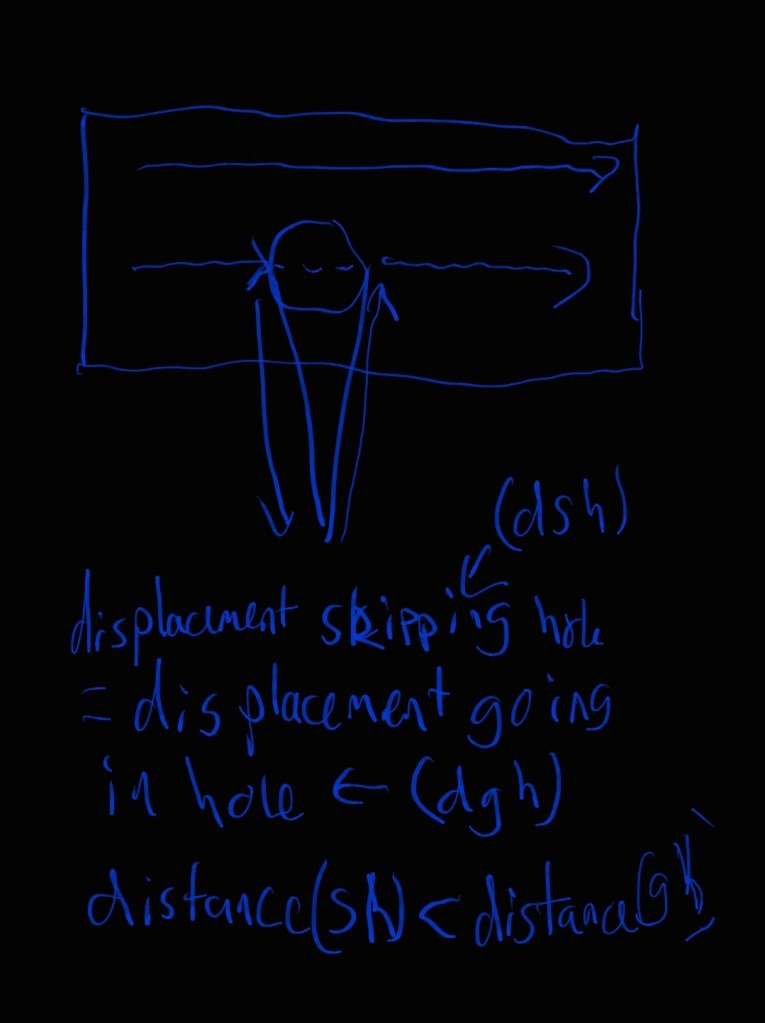
I imagine space-time like a sheet, and planets, stars, etc. make an indent on that sheet. The more massive the object, the bigger the indent. ….《COME BACK TO EXPLANATION LATER》
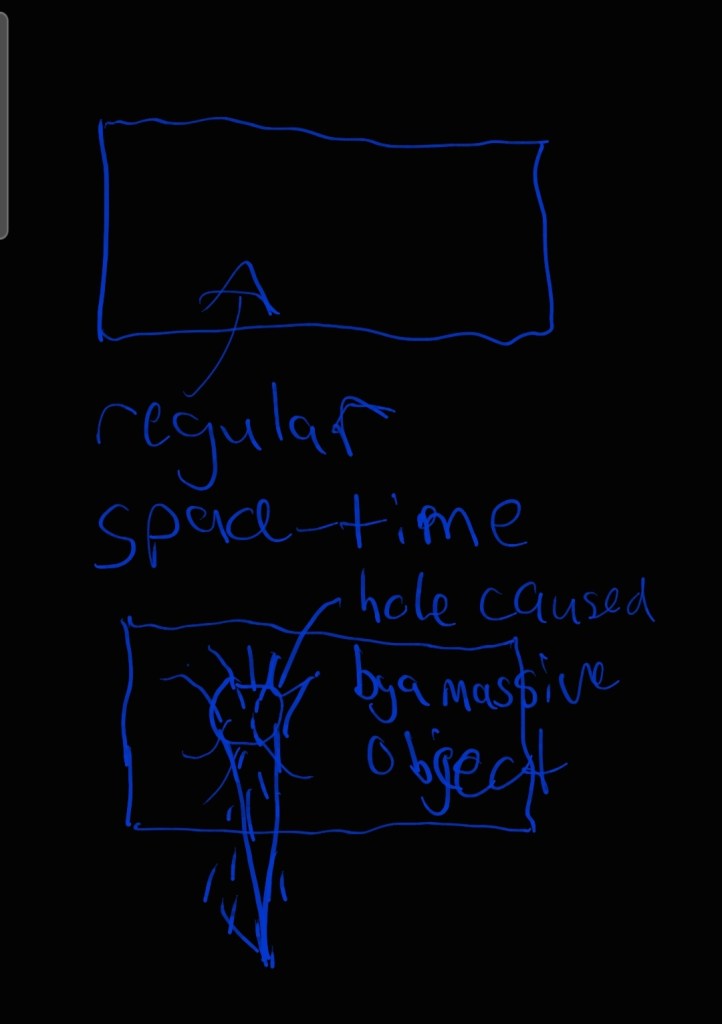
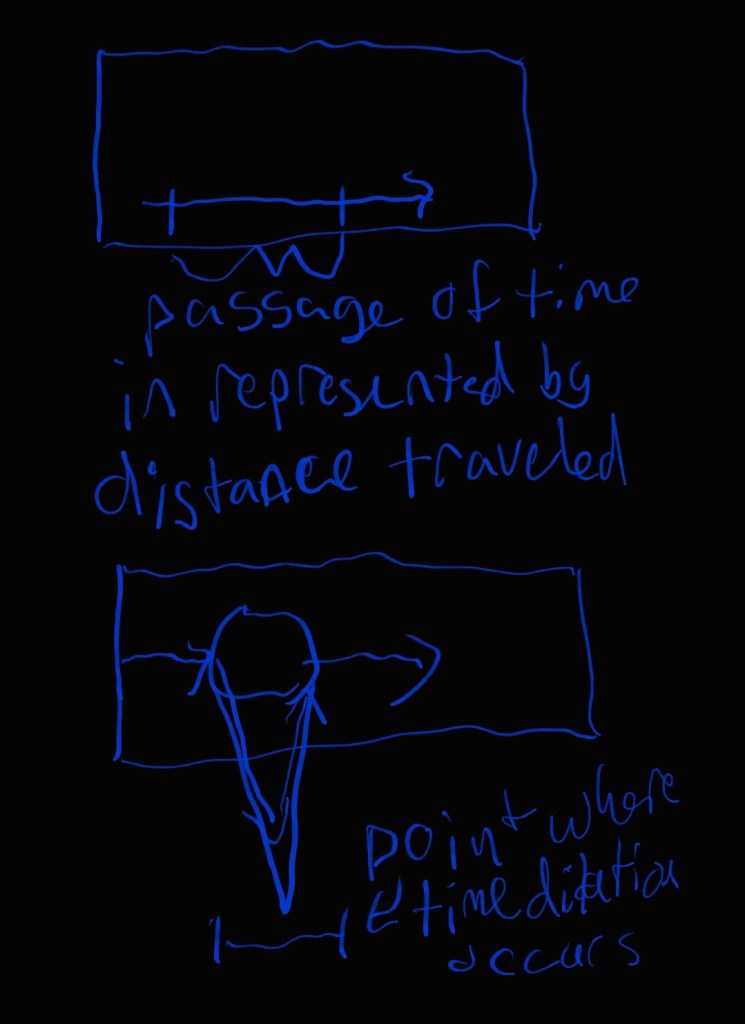
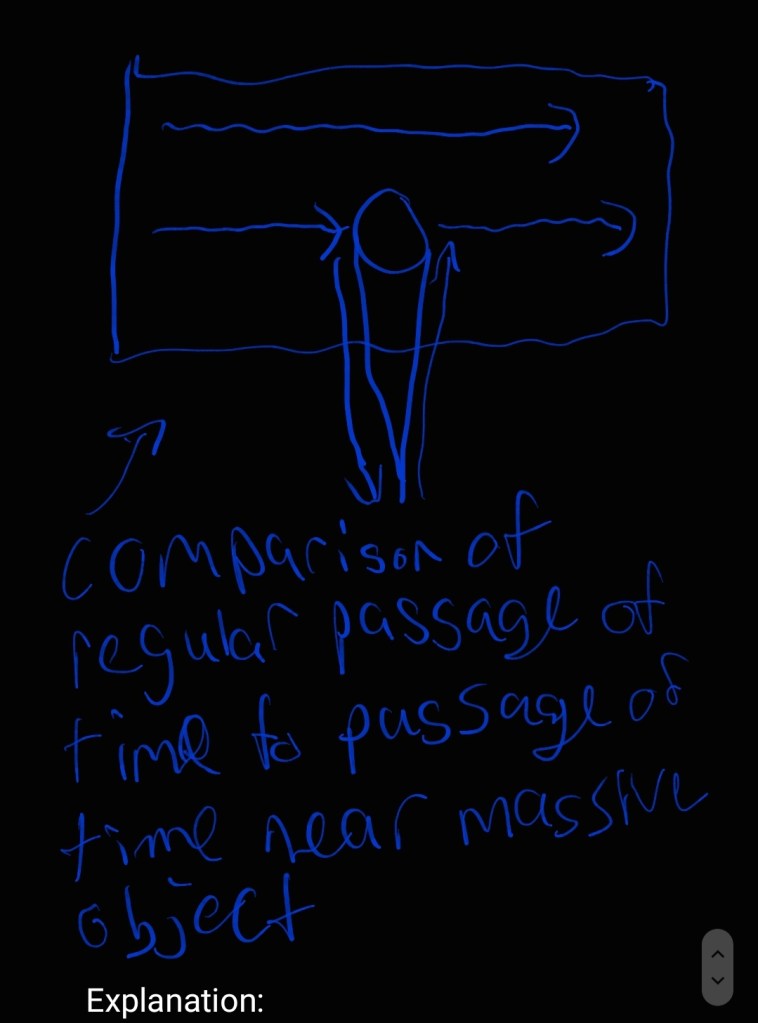
When traveling through space-time, you tend to go at a relatively constant rate. There are probably slight changes in rate, but not enough for the average person to notice. However, when you approach a massive object, it creates an indent/hole. Similar to a ball rolling down a hill, when you get to the home, your rate increases immensely. If you go down the hole and then back out, you can look across the hole, rather than down the hole. Since the diameter of the hole is much smaller than the depth, it looks/feels like you didn’t travel that far. However, in the hole, you traveled the distance both down and up it. And though your rate increases going down, it decreases going up. If you went down the hole, continued your momentum without any loss ood energy, and went straight back up, the time to travel next to the hole would be about the same as the time to go into the hole, since the increased rate followed by the decreased rate average out. However, let’s say you completely stop at the bottom of the hole. Unless you could produce the same amount of energy of going down, your average rate would be slower when leaving the hole.
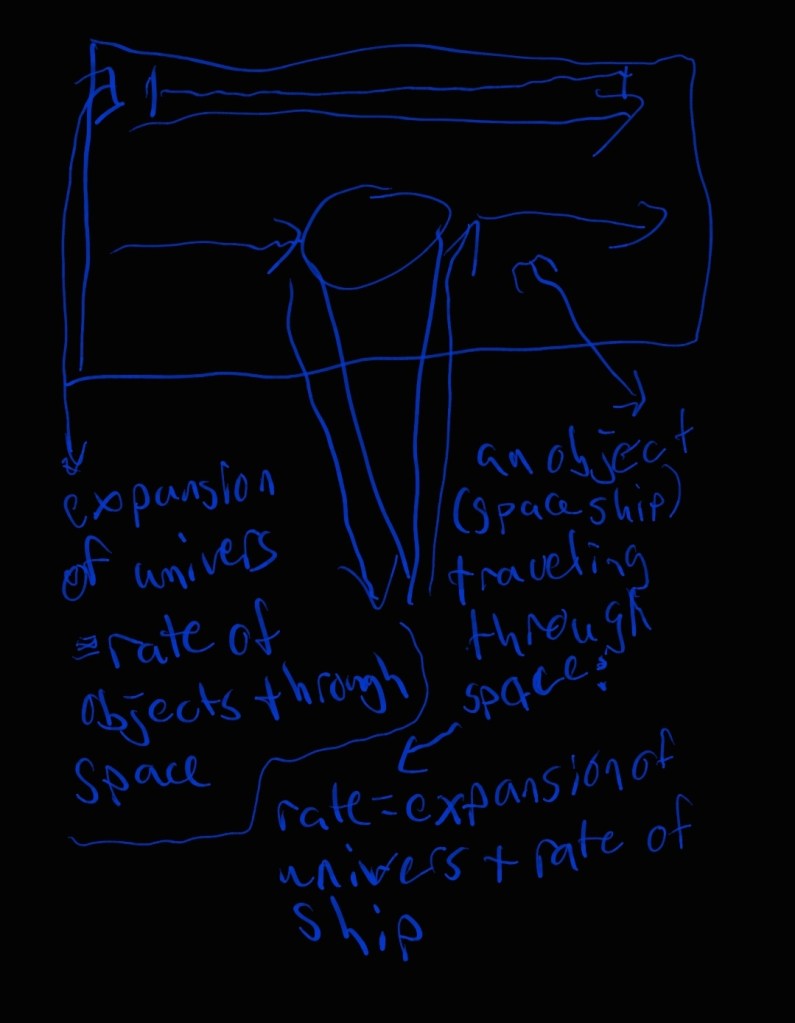
So how does this cause time dilation, and how would we perceive it. The example I’m going to use is from “Intersellar”, when the two astronauts go to the water planet near the black hole while one stays in the ship. I’m that scene, the people on the planet are there for a coupe hours or something like that, but when they return to the ship, the other astronaut had aged by years. The reason for this is that the ones on the planet traveled much further distance wise due to going down the hole caused by the black hole. However, the increased rate going down, plus their ability to match a similar rate coming out made that extra distance negligible to them. So the only change in space they could feel was the movement of the planet through space. However, the ship away from the planet didn’t experienced the increase rate. But by looking at time as a measurement of distance, he had to travel the same distance as the ones on the planet, but at the normal, slow rate. And so, in order to remain at the same location as the ones on the planet, he traveled the same distance as if he went into the hole himself, but at a constant rate, rather than an increasing rate. 《COME BACK TO EXPLANATION》

 ♡Sugar☆World☮