
Have you not heard of that madman who lit a lantern in the bright morning hours, ran to the market place, and cried incessantly: “I seek God! I seek God!” — As many of those who did not believe in God were standing around just then, he provoked much laughter. Has he got lost? asked one. Did he lose his way like a child? asked another. Or is he hiding? Is he afraid of us? Has he gone on a voyage? emigrated? — Thus they yelled and laughed.
The madman jumped into their midst and pierced them with his eyes. “Whither is God?” he cried; “I will tell you. We have killed him — you and I. All of us are his murderers. But how did we do this? How could we drink up the sea? Who gave us the sponge to wipe away the entire horizon? What were we doing when we unchained this earth from its sun? Whither is it moving now? Whither are we moving? Away from all suns? Are we not plunging continually? Backward, sideward, forward, in all directions? Is there still any up or down? Are we not straying, as through an infinite nothing? Do we not feel the breath of empty space? Has it not become colder? Is not night continually closing in on us? Do we not need to light lanterns in the morning? Do we hear nothing as yet of the noise of the gravediggers who are burying God? Do we smell nothing as yet of the divine decomposition? Gods, too, decompose. God is dead. God remains dead. And we have killed him.
“How shall we comfort ourselves, the murderers of all murderers? What was holiest and mightiest of all that the world has yet owned has bled to death under our knives: who will wipe this blood off us? What water is there for us to clean ourselves? What festivals of atonement, what sacred games shall we have to invent? Is not the greatness of this deed too great for us? Must we ourselves not become gods simply to appear worthy of it? There has never been a greater deed; and whoever is born after us — for the sake of this deed he will belong to a higher history than all history hitherto.”
Here the madman fell silent and looked again at his listeners; and they, too, were silent and stared at him in astonishment. At last he threw his lantern on the ground, and it broke into pieces and went out. “I have come too early,” he said then; “my time is not yet. This tremendous event is still on its way, still wandering; it has not yet reached the ears of men. Lightning and thunder require time; the light of the stars requires time; deeds, though done, still require time to be seen and heard. This deed is still more distant from them than most distant stars — and yet they have done it themselves.
It has been related further that on the same day the madman forced his way into several churches and there struck up his requiem aeternam deo. Led out and called to account, he is said always to have replied nothing but: “What after all are these churches now if they are not the tombs and sepulchers of God?”
https://www.allaboutphilosophy.org/nietzsche-and-the-madman.htm

“God is Dead,” Nietzsche proclaimed. But he did not say this on a note of triumph, in the style of earlier atheism – the tyrant has been overthrown and man is now free. Rather he said it in the anguished tones of the most powerful and delicate piety deprived of its proper object. Man, who loved and needed God, has lost his Father and Savior without possibility of resurrection. The joy of liberation one finds in Marx has turned into terror at man’s unprotectedness. Honesty compels serious men, on examination of their consciences, to admit that the old faith is no longer compelling. It is the very peak of Christian virtue that demands the sacrifice of Christianity, the greatest sacrifice a Christian can make.
Enlightenment killed God; but like Macbeth, the men of the Enlightenment did not know that the cosmos would rebel at the deed, and the world become “a tale told by an idiot, full of sound and fury, signifying nothing.”1
God is Dead — Nietzsche Declares the Intolerable
By declaring, “God is Dead,” Nietzsche is waking the Western world to the consequences of Divine homicide.
“Nietzsche replaces easygoing or self-satisfied atheism with agonized atheism, suffering its human consequences. Longing to believe, along with intransigent refusal to satisfy that longing, is, according to him, the profound response to our entire spiritual condition. Nietzsche surveyed and summed up the contradictory strands of modern thought and concluded that victorious rationalism is unable to rule in culture or soul, that it cannot defend itself theoretically and that its human consequences are intolerable.”2
Footnotes:
1 Allan Bloom, The Closing of the American Mind (Simon & Schuster, New York, 1987), pp. 195-96.
2 Ibid. p. 196.
https://www.allaboutphilosophy.org/god-is-dead-nietzsche-proclaimed-faq.htm
⎈
Ñü∿ΣИD 4 Final Beginning Grand Finale [Revision♪Яequiem]
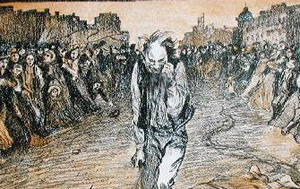
156 – A Mad Prophet [Revision]
181 – (Light) öF The §Øü1 [Revision♪Requiem]
“The War Resumes” | 17 September 2021

 ♡Sugar☆World☮